About Bosmarlin
Bosmarlin is a small ceramics workshop with one job: glazed stoneware that people use every day rather than keep for visitors.
We make mugs, bowls, plates and a few pieces for the oven. We stay deliberately narrow in shape and wide in glaze, because a shelf looks best when the forms agree with each other and the colours do not have to. That single decision explains most of what you see here: 22 distinct shapes, 64 named colours across them, and sets that match without being uniform.
The work runs in the ordinary order. We choose clay for weight and hardness, throw shapes in small batches, bisque-fire them, then glaze by hand and fire again. The second firing is where the character arrives. Our reactive glazes carry mineral oxides that move in the heat, so the kiln, not a brush, finishes the boundary between two colours.
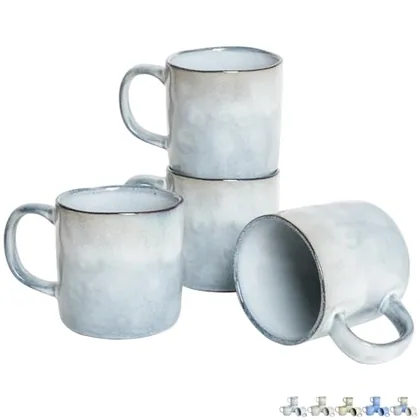 Mug Sets102 pieces
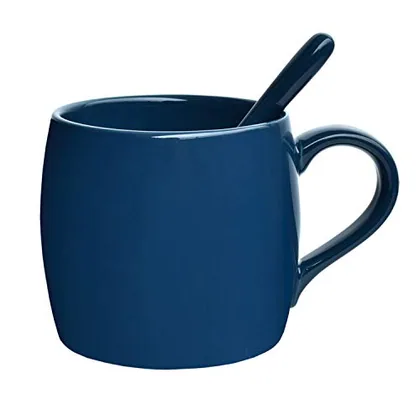 Everyday Mugs49 pieces
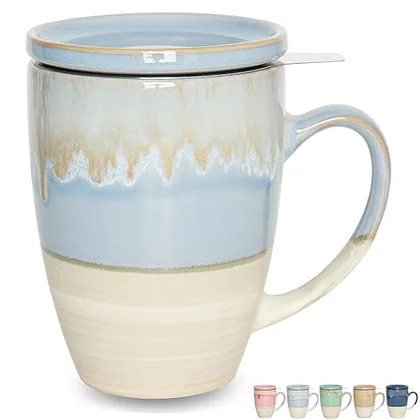 Tea Infuser Mugs43 pieces
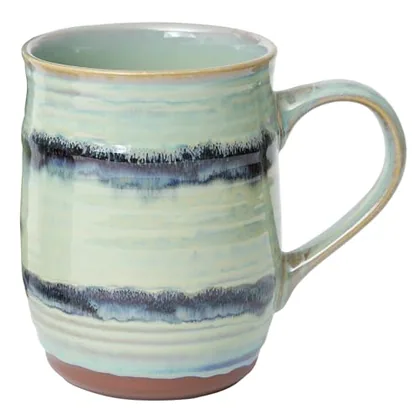 Oversized Mugs34 pieces
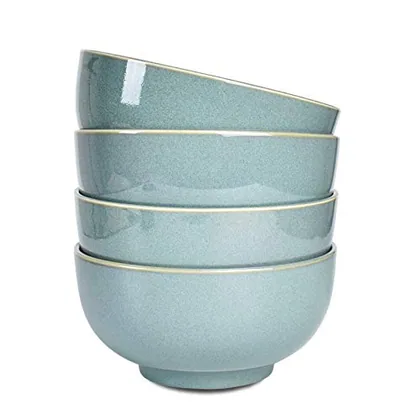 Bowls28 pieces
We look at every piece before it goes into a box, and we do not send out the ones where the glaze pooled badly or pulled back from an edge. That is the whole quality story.
What we do not do is worth saying plainly, because plenty of sites this size are vague about it. We are not a shop counter. Ordering, payment, delivery and returns happen at checkout with the retail partner, and any question about a parcel belongs to them rather than to us. What belongs to us is the clay, the glaze and what comes out of the kiln.
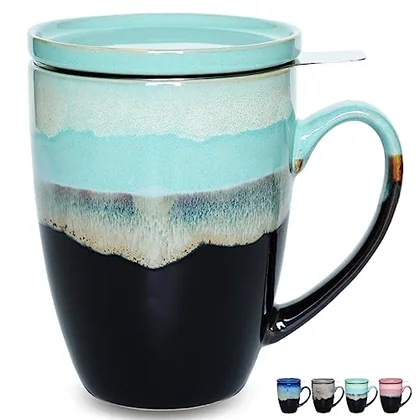
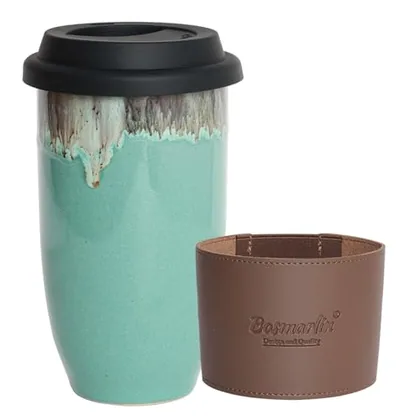
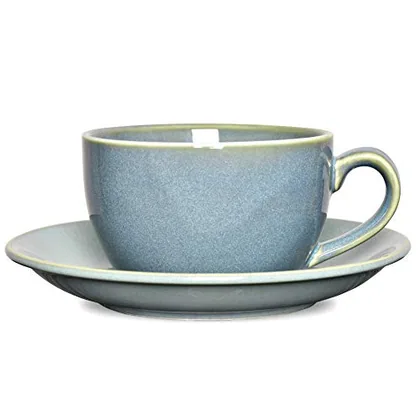
The workshop, in five parts
We start with the clay body, not the colour
Stoneware is the whole reason a Bosmarlin mug feels the way it does. It is fired hard and dense, so it holds heat longer than a thin porcelain cup and shrugs off the knock against a tap that would chip something finer. It is heavier in the hand, and we think that weight is a feature rather than a cost: a mug that sits still on a desk is a mug that does not go over when a cable catches it.
The trade is that stoneware asks for a thicker wall and a wider foot, and both of those shape the pieces you see here. We do not make anything delicate. Everything in it is meant to be used on a weekday.
- 1. Clay firstStoneware is chosen for weight and for how hard it fires, before anyone talks about colour.
- 2. Dipped by handThe piece goes into the glaze and comes out wearing it. Thickness is a decision, not an accident.
- 3. Foot wiped bareGlaze is glass and glass sticks. The ring is wiped back to raw clay so the piece leaves the shelf in one part.
- 4. Fired, then looked atHeat draws the band where the colours meet. Pieces that pooled or crawled do not go in a box.
The glaze is mixed to move
A reactive glaze carries mineral oxides that stay put at room temperature and travel once the kiln is hot. The band where two colours meet is not painted on. It is drawn by heat, by how thickly the glaze went on, and by where the piece stood on the shelf.
That is why the same Bosmarlin glaze can come out as a soft fade on one mug and a sharp break on the next. The photograph on a page is a fair picture of the glaze, not a portrait of the exact piece that arrives.
Glazing is done by hand, and the foot is left bare
Pieces are dipped, then wiped back around the foot ring. The bare ring is not an oversight. Glaze is glass, and glass sticks: a piece glazed all the way down welds itself to the kiln shelf and comes off in pieces.
You can feel that ring on the bottom of every mug and bowl we make. It is the one part of a Bosmarlin piece that is still raw clay, and it is the quickest way to tell fired stoneware from something that was only painted to look like it.
- Built for the mugs you fill to the top, where a small loop turns the weight into a pinch.
- 102 of our pieces hold 20 oz or more, and those are the ones that need it.
- A cappuccino cup does not need a hand through it, and a big handle would unbalance the saucer.
- The pull is sized to the drink rather than to the photograph.
Handles are big because full mugs are heavy
A 21 oz mug with coffee in it is a real weight, and a small handle turns that weight into a pinch between two fingers. Our large mugs carry a handle you can put a whole hand through, and the wide ones carry a low, deep pull rather than a narrow loop.
It is a plain piece of ergonomics that gets skipped often, and it is the first thing people notice when they pick one up.
| Pack | How many we make | Per piece |
|---|---|---|
| Set of 2 | 63 pieces | $7.00 to $15.49 |
| Set of 3 | 1 piece | $7.00 to $7.00 |
| Set of 4 | 92 pieces | $4.75 to $11.50 |
| Set of 6 | 8 pieces | $3.00 to $5.17 |
Every piece is looked at before it is packed
Reactive glaze runs. Most of the time it runs the way we want it. Sometimes it pools at the foot, or it crawls back from an edge and leaves the clay bare where it should not be, and those pieces do not go out.
We would rather send a smaller batch than teach people that a Bosmarlin glaze is a lottery. The variation you get is the variation we chose to keep.
Prices
A piece that has no buyable price leaves the range until it returns, so every price you see is one you can pay.